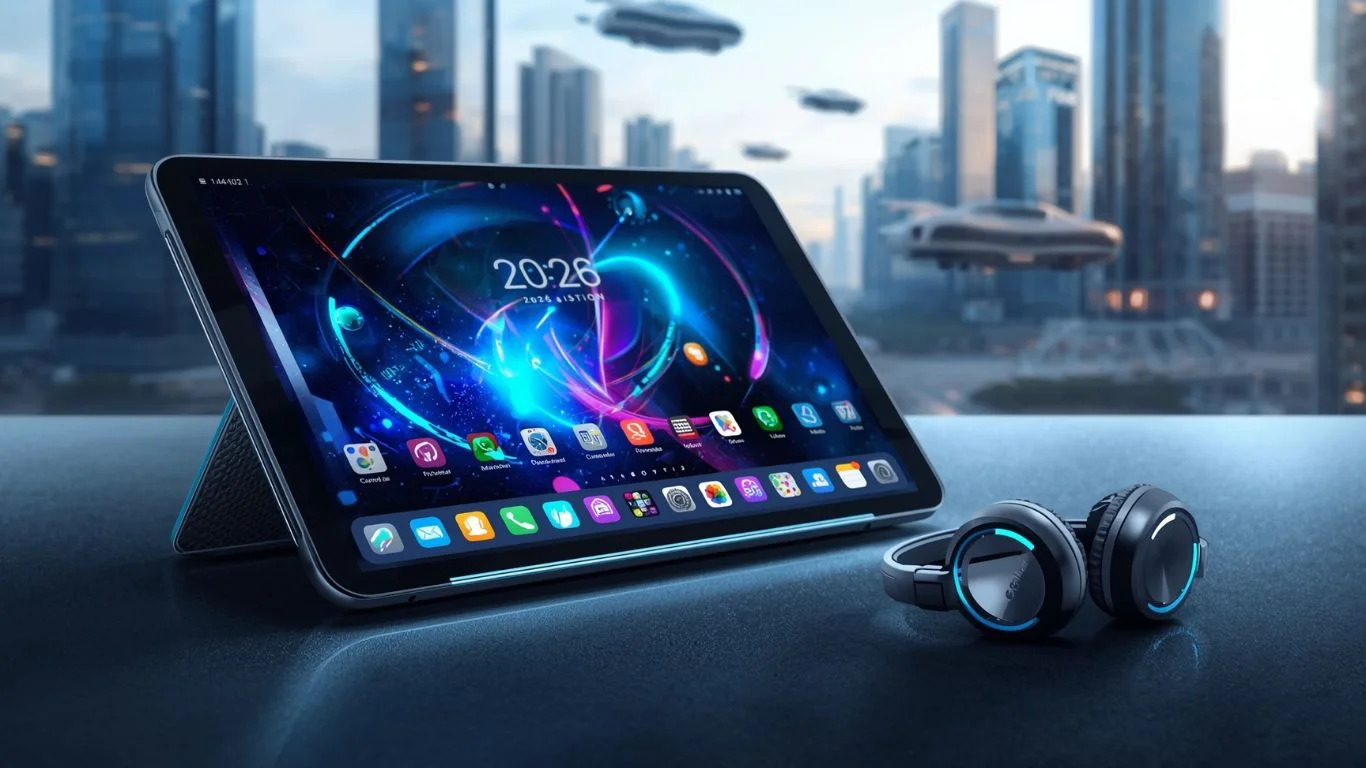
As we hurtle toward 2026, the tablet market is quietly gearing up for some noticeable shifts. While tablets may not grab the same frenzy as smartphones, the changes ahead are meaningful — from visuals and performance to form‑factors and use cases. Here’s a breakdown of what to expect, and why you might want to keep an eye on the next‑gen tablets.
🔍 Key Trends for Tablets in 2026
1. Displays Get a Big Visual Boost
One of the most obvious changes: many tablets will move from LCD to OLED or similarly advanced panels. Reports suggest that OLED tablet‑panel shipments are set to jump strongly in 2026, marking a turning point for large‑screen devices.
For example, the compact tablet from Apple (likely the next‑generation iPad mini) is rumoured to adopt OLED in 2026 — up from its current LCD.
Why this matters: richer contrast, deeper blacks, better colour reproduction, and (often) better energy efficiency. For tablets used for media, creative work or general lounging, this is a meaningful upgrade.
2. Stronger Performance, Smarter Features
Tablets are getting more ambitious in 2026. They’re not just larger phones — many are drifting toward laptop‐replacement territory. With faster processors, better multitasking support, stylus/keyboard accessories, the gap between tablet and PC continues to blur.
However, some market data suggests the overall tablet segment is entering a slower refresh cycle — meaning fewer people upgrade frequently.
For you: if your current tablet is a few years old, upgrades now may feel more noticeable than they would in a rapidly saturating market.
3. Diversified Form‑Factors
Expect tablets not just in “standard” sizes. Smaller high‑end tablets (think 8‑10″) or extra‑large (13‑14″) may gain traction. Brands are exploring options beyond “just a bigger phone”.
For instance: the iPad mini’s OLED jump suggests smaller but premium tablets still matter. And larger tablets are catering to productivity, drawing and content‑creation.
Also, features like 5G connectivity, stylus input, detachable keyboards and hinge keyboards may become more common as tablets aim to replace or complement laptops.
4. Productivity and Ecosystem Integration
Tablets in 2026 will increasingly be about more than just media consumption. They’ll be about doing things: drawing, editing, multitasking, remote work, hybrid school/office scenarios.
Support for styluses, keyboard covers, docking modes, desktop‑style UI layouts will matter more. Software ecosystems will play a big role.
And because tablets aren’t replaced as often as phones, manufacturers are under pressure to offer longer software update windows and durable support.
5. Market Dynamics & What It Means for Buyers
Even though there are meaningful upgrades, the tablet market is showing signs of saturation and longer replacement cycles. Analyses predict that by 2026 the average tablet owner will hold onto their device longer.
That means: brands will need to persuade you with worthwhile upgrades — not just incremental changes. And as a buyer you’ll want to ask: “Will this really make my life meaningfully better?”
📌 What to Expect (and Consider) If You’re Shopping for a 2026 Tablet
✅ If you’re buying now
- If your current tablet is getting sluggish or lacks needed features, you don’t have to wait for 2026. Current models (2024‑25) are still very capable.
- But if you can wait, holding off may bring you meaningful upgrades: OLED display, stronger chipset, better stylus support or new form‑factor.
🎯 If you’re targetting 2026
- Prioritise features: display (OLED vs LCD), refresh rate, size, stylus/keyboard support, connectivity (5G/WiFi 7), ecosystem.
- Think about how you use it: media consumption vs drawing/editing vs productivity vs schooling.
- Check software support: how many years of OS/security updates the brand promises — this matters when you hold the device a long time.
- Be aware of pricing: advanced features = premium cost. With longer replacement cycles, value becomes more important.
🔮 Final Thoughts
2026 looks to be an important year for tablets — not because every tablet will suddenly be revolutionary, but because several meaningful upgrades are converging: better displays, stronger performance, deeper productivity features and more refined form‑factors.
If you’re in the market, it’s a good time to watch closely: you might find a model that significantly raises the bar for your use case. And if you already have something decent, you might not need to upgrade immediately unless there’s a specific feature you’re after.
If you like, I can pull together rumoured models & expected release timelines for 2026 tablets (with speculation for major brands) so you can see what might be coming. Would you like that?
FAQs on Upcoming Tablets in 2026
In 2026, expect advancements like OLED displays, improved performance with faster processors, new form factors (including smaller premium tablets), enhanced productivity features, and longer software support.
Yes, many tablets in 2026 will be designed to offer productivity features like keyboard support, stylus compatibility, multi-window multitasking, and desktop-style user interfaces, making them better suited for work and creative tasks.
OLED displays are expected to be more common in premium tablets in 2026, especially in models like the iPad mini. However, budget models may still rely on LCD or LED technology, with OLED reserved for higher-end devices.
Tablets will see faster processors, with many using chips based on 3nm or 2nm processes, resulting in better performance, energy efficiency, and longer battery life. These upgrades will enable smoother multitasking and better overall user experience.
If you’re looking for major upgrades like OLED displays, better performance, or productivity features, it might be worth waiting for 2026. However, if your current tablet still meets your needs, there are plenty of great options available now.